 Quize
How ALEKS Works: Knowledge Checks, Pie & Tips
November 12, 2026 · The QuizeGpt Team · 9 min read
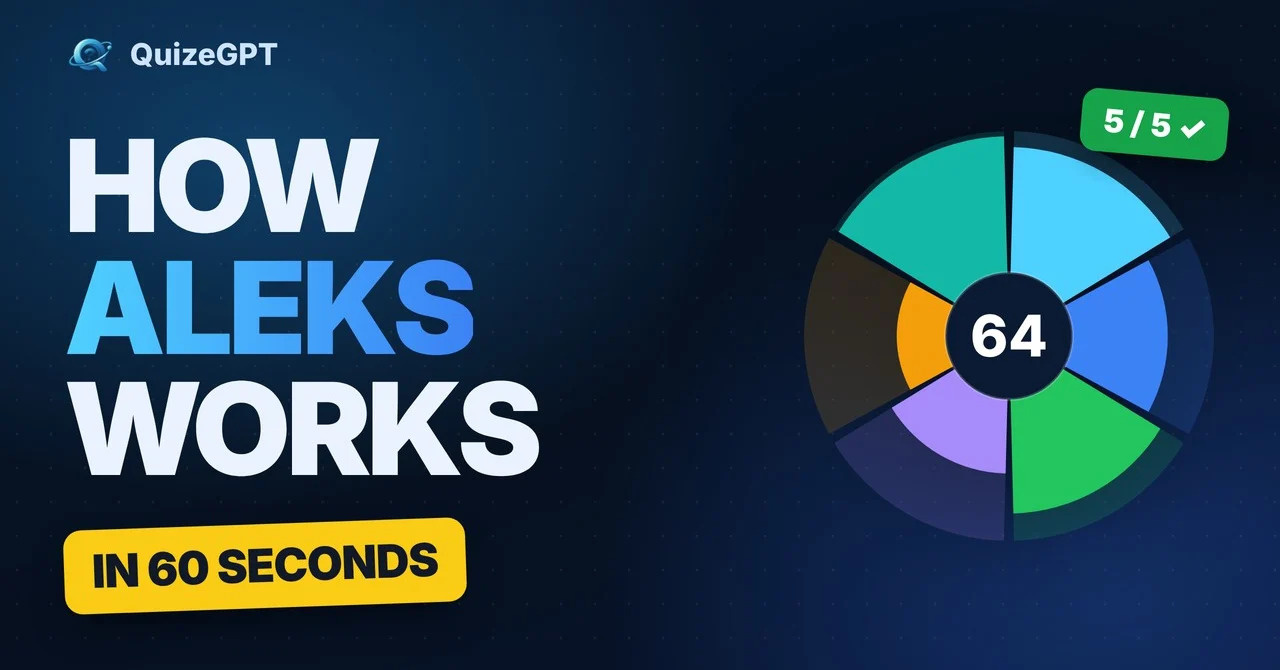
Quick answer: ALEKS is McGraw Hill's adaptive learning platform. It starts with an Initial Knowledge Check of about 20 to 30 questions to map what you already know. You then practice new topics in the Learning Path, where earning 5 points marks a topic as learned. Regular Knowledge Checks test what you remember, and forgotten topics go back into your path.
If you've ever opened ALEKS, worked for an hour, and then watched topics vanish from your pie after a surprise Knowledge Check, you're not alone. ALEKS can feel random. It isn't.
Once you understand how ALEKS works, the pie, the points, and the checks all make sense. And when they make sense, you can stop fighting the system and start moving through it faster.
This guide answers "how does ALEKS work?" step by step. We'll cover the Initial Knowledge Check, the ALEKS pie, the 5-point rule, learned vs mastered, and why ALEKS keeps testing you. Then we'll share 9 practical tips to finish your ALEKS work in less time, without just guessing your way through.

What is ALEKS?
ALEKS (Assessment and LEarning in Knowledge Spaces) is an adaptive learning platform from McGraw Hill. Schools and colleges use it for math, chemistry, statistics, accounting and more.
The key word is adaptive. ALEKS doesn't give every student the same homework. Instead, it tries to figure out exactly what you already know, what you don't know, and what you're ready to learn next. Then it only gives you problems from that "ready to learn" zone.
That's why two students in the same class can see completely different topics on the same day. It also explains most of the things that feel strange about ALEKS. Everything is built around one idea: your knowledge state, which is ALEKS's map of what you know right now.
What is the ALEKS Initial Knowledge Check?
The first time you log in, ALEKS gives you an Initial Knowledge Check. According to McGraw Hill, a Knowledge Check asks about 20 to 30 questions. Each new question is chosen based on how you answered the one before it. You can't skip it.
Two things surprise most students:
You don't see if you're right or wrong. ALEKS is measuring you, not teaching you, so there's no feedback during the check.
There's an "I don't know" button, and you should use it. If you truly don't know how to solve a problem, click it. Guessing is the biggest mistake students make here.
Why is guessing bad? If you guess and get lucky, ALEKS thinks you know that topic and skips it. Later, you'll face harder topics that depend on it, and you'll struggle. Even worse, the next Knowledge Check will catch the gap and remove those topics from your pie.
An honest Initial Knowledge Check is the fastest path overall. It puts you at the right starting point, so you don't waste hours on topics that are too hard.
What does the ALEKS pie mean?
After your Initial Knowledge Check, you'll see the famous ALEKS pie. It's a visual map of your course.
Each slice is a subject area of the course, like equations, functions or exponents.
The filled part of each slice shows the topics you've already learned or mastered.
The number in the middle counts your total mastered and learned topics.
When you learn a new topic, ALEKS adds it to your pie and to the Learned part of your progress bar.
One thing confuses a lot of students: a slice can look almost full but still have topics you can't open. For example, a slice might show 8 of 10 topics done, but the last 2 are locked. That happens because they need prerequisites from a different slice. So if one slice seems stuck, the fix is often to work on another one first.
How do you learn a topic in ALEKS?
Most of your time in ALEKS is spent in the Learning Path. This is where you practice the topics you're "ready to learn." ALEKS loads them automatically and sorts them from easiest to hardest.
You can also open the Topic Carousel with the arrow in the top-left corner. Each topic has its own card, and you can switch topics without losing progress on the ones you started. Topics with a lock icon need prerequisites first.
How many points do you need to learn a topic?
This is the rule that matters most. McGraw Hill explains it like this:
A correct answer gives you 1 point.
Two correct answers in a row, without opening the Explanation, give you 2 points.
A wrong answer takes away 1 point. Your score never goes below zero.
Opening the Explanation doesn't add or remove points.
When you reach 5 points, the topic is learned and added to your pie.
So the fastest way through a topic is a streak of correct answers, without opening the Explanation. A careless mistake costs you a point and breaks your streak, so slowing down a little is often faster in the end.
Use the Explanation the smart way
The Explanation button shows a full step-by-step solution for the problem in front of you. Use it when you're stuck, then compare its steps with yours to find exactly where you went wrong. Then try the next problem on your own.
There's also a Review section in the menu. It lets you practice topics you already learned, and it doesn't affect your knowledge state. It's a safe place to warm up before a Knowledge Check.
Learned vs mastered: what's the difference?
Your progress bar splits finished topics into two groups:
Status | What it means |
|---|---|
Learned | You practiced the topic successfully in the Learning Path, but ALEKS hasn't tested it in a Knowledge Check yet. |
Mastered | You showed you still know the topic in a Knowledge Check. |
Remaining | Topics you still need to work through. |
Think of "learned" as passed practice and "mastered" as passed the test later. Learned topics are not safe yet. They only become mastered after you prove you still remember them.
Why does ALEKS keep giving me Knowledge Checks?
This is the part students hate the most. You're making progress, and then ALEKS stops you for another Knowledge Check. Sometimes your pie even shrinks afterwards.
ALEKS does this on purpose. It wants to make sure you remember what you learned, not just that you got it right once. McGraw Hill says new Knowledge Checks usually appear:
After you learn 20 topics and spend 5 hours in learning mode
After 10 hours in learning mode
After 60 days without a Knowledge Check (30 days for Higher Education Chemistry)
Sometimes after a module's due date, depending on your course
Your instructor's course settings may also affect when checks appear.
Why topics disappear from your pie
If you answer a question wrong, or click "I don't know," in a Knowledge Check, ALEKS decides you haven't kept that topic. It moves the topic from Learned or Mastered back to Remaining and puts it in your Learning Path again. Topics linked to it may come back too.
It feels like a punishment, but it's really a memory test. And the good news is that relearning a topic is often much faster the second time.
How can you get through ALEKS faster? 9 tips
Now that you know how ALEKS works, here's how to use it to your advantage.
Be honest in Knowledge Checks. Click "I don't know" instead of guessing. A lucky guess only creates a gap that the next check will find, and you'll lose more time later.
Protect your streak. Two correct answers in a row earn 2 points. Check every answer before you submit, especially signs, units and rounding. One careless mistake costs a point and resets the streak.
Use the Explanation once, then go solo. When you're stuck, read the Explanation and copy the method onto paper. Then solve the next problem yourself. That's how you build the streak.
Work in short, regular sessions. Thirty minutes a day beats one long night before the deadline. Your memory holds topics better when practice is spread out, which is the idea behind spaced repetition.
Review before a Knowledge Check. Spend 10 minutes in Review on recently learned topics. It doesn't affect your score, and it helps you keep topics in your pie.
Unlock stuck slices from other slices. If a slice won't move, its next topics probably need prerequisites from somewhere else. Open the Topic Carousel and work on a different slice first.
Start with easier topics. ALEKS already sorts ready topics from easiest to hardest. Early wins add to your pie quickly and unlock the next topics.
Keep a notebook of methods. Write down the steps for each topic type. When the same skill shows up in a Knowledge Check weeks later, a quick look at your notes brings it back. This is active recall in action.
Fix weak basics first. Many ALEKS math topics depend on algebra skills like factoring, fractions and solving equations. If those feel shaky, fixing them first will speed up everything else. Our algebra solver shows each step so you can see where you go wrong.
How can QuizeGPT help with ALEKS?
ALEKS's own Explanation is helpful, but sometimes you need a different way of seeing a problem, or you want to ask "why?" one more time.
That's where QuizeGPT helps. It's a Chrome extension that sits in the corner of your screen. Click it on an ALEKS practice problem and it gives you a clear, step-by-step explanation. Still confused? Ask a follow-up question, like you would with a tutor.
Use it to understand the method, then solve the next problem yourself to build your streak. QuizeGPT is a study aid. It's made for practice and homework, and it won't run on live graded or proctored assessments.
See how QuizeGPT works with ALEKS, or browse all supported platforms.
ALEKS FAQ
How many questions are in an ALEKS Knowledge Check?
About 20 to 30 questions, according to McGraw Hill. The exact number depends on your answers, because each question is chosen based on the one before it.
How many correct answers do you need to learn a topic in ALEKS?
You need 5 points. Each correct answer gives 1 point, two correct in a row without the Explanation give 2 points, and each wrong answer takes away 1 point.
Does using the Explanation lower my score?
No. Opening the Explanation doesn't add or remove points. But the 2-point bonus only counts when you answer correctly twice in a row without using it.
Why did my ALEKS pie go down?
A Knowledge Check found topics you didn't remember. ALEKS moved them back to Remaining so you can relearn them.
Should I click "I don't know" in ALEKS?
Yes, when you really don't know. Guessing can place you in topics you're not ready for, which slows you down later.
What's the difference between learned and mastered in ALEKS?
Learned means you passed the topic in practice. Mastered means you also got it right in a later Knowledge Check.
Sources
McGraw Hill: What is an ALEKS Knowledge Check?
McGraw Hill: Why does ALEKS periodically give me new Knowledge Checks?
McGraw Hill: How many correct answers are needed to learn a topic?
McGraw Hill: How much does a student have to practice a topic to learn it?
McGraw Hill: Learned vs mastered ALEKS topics
McGraw Hill: What is the ALEKS Learning Path?
QuizeGPT is not affiliated with McGraw Hill or ALEKS. ALEKS is a trademark of its owner.